The Burncast Blog
Practical guidance on startup financial modeling, fundraising, and making better decisions with your numbers.
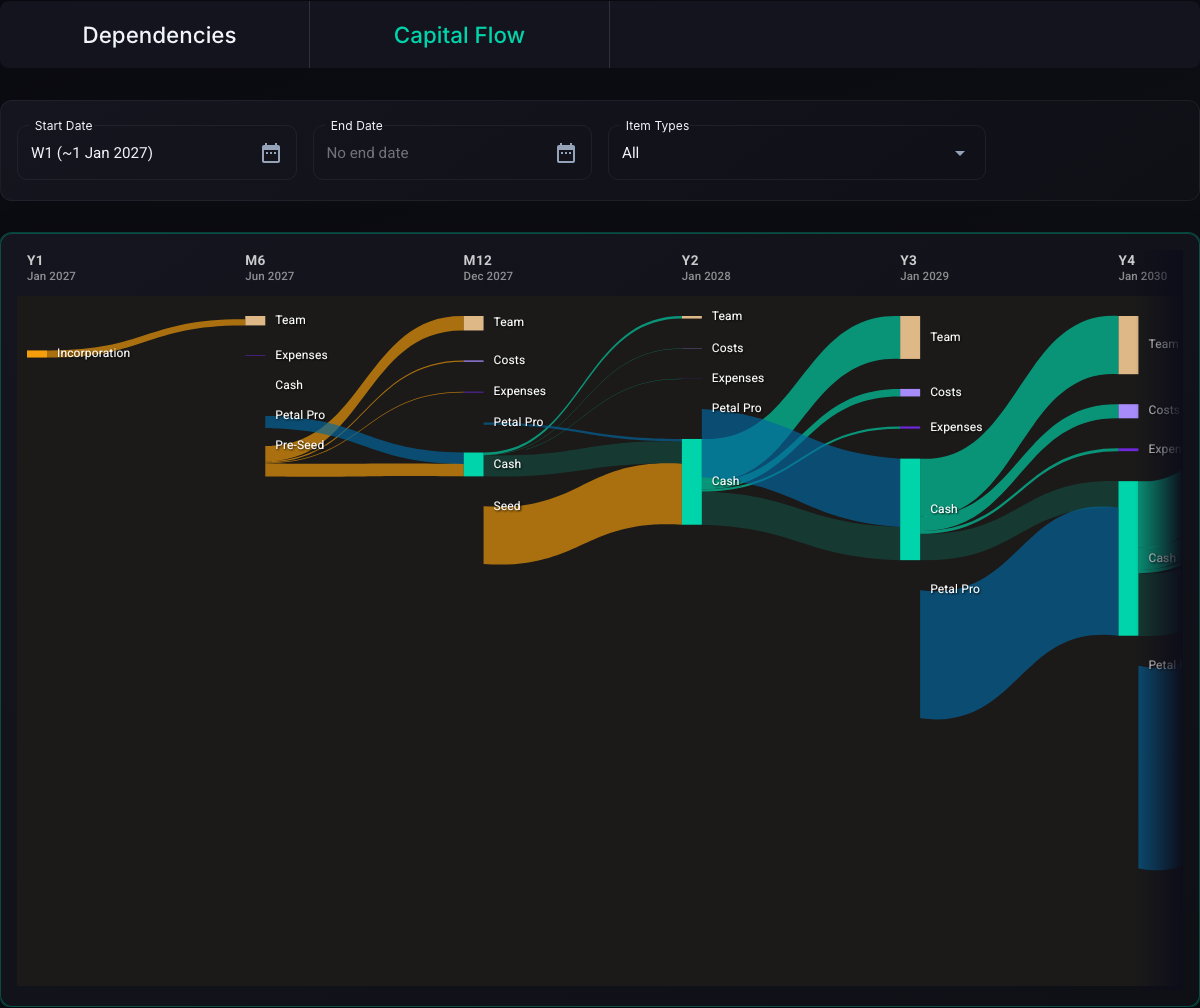
The hardest errors in a financial model are often not arithmetic errors. They are connection errors. A sales-driven revenue stream can be linked to the wrong role. An expense can draw its budget from the wrong funding round. A hiring plan can begin before the cash expected to support it arrives. The projections still calculate, so the problem may not be obvious in a statement or summary metric. The new Visualizations page gives you two ways to inspect the model behind the totals: ...

Most startup financial models treat hiring plans and budgets as separate things. You plan to raise $4M, and separately you plan to hire 8 engineers. But those two numbers are connected: the engineers are funded by the round. If the round comes in at $2M instead of $4M, the hiring plan should change. In a spreadsheet, you update both manually, then check the statements tab to make sure nothing broke downstream. Change one cell, verify ten others. This is exactly the kind of fragile linking that makes spreadsheet models a liability. ...
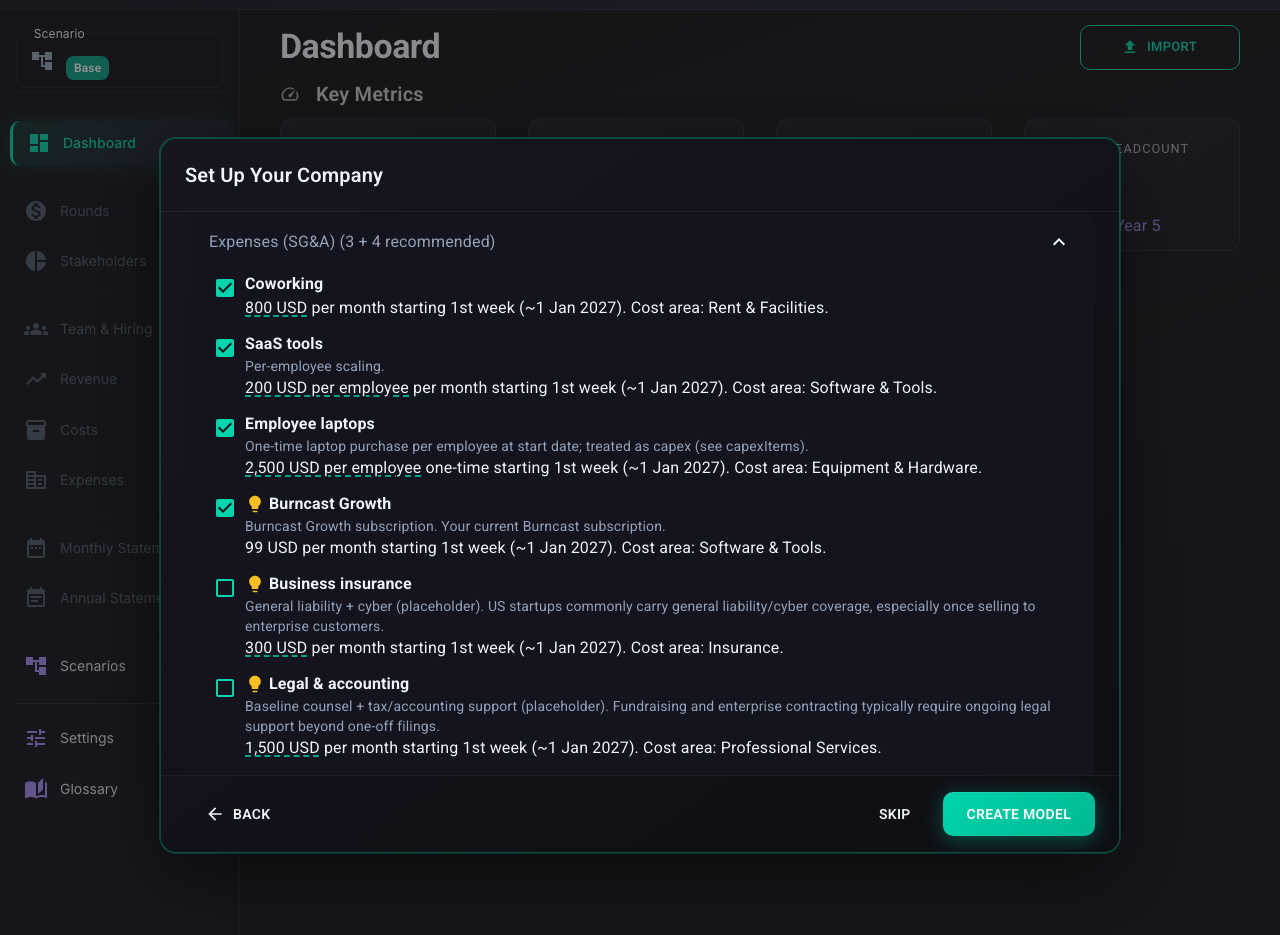
Building a financial model usually starts with a blank page and a lot of clicking. Add a team role, fill in salary, set a start date, save. Now do it again for revenue, costs, and funding rounds. By the time you reach the projections tab, you have spent 30 minutes on data entry and have not made a single strategic decision. We wanted to fix that. Starting today, you can describe your business in plain text and Burncast builds the model for you. ...

Three questions every founder should be able to answer in under a minute: What if we raise 50% less than we want? What if we double our growth rate? What if we hire 3 more engineers? These are not hypothetical exercises. They come up in board meetings, investor calls, and late-night planning sessions. But answering them usually means opening a dialog, changing a number, saving, waiting for projections to recalculate, and then undoing everything because you were just exploring. Or worse, if you are using a spreadsheet: changing a cell, scanning downstream formulas for breakage, and hoping you did not miss one three tabs over. Most founders skip it. ...

BILL is shutting down Finmark on April 1, 2026. If you’re one of the thousands of founders who used it to build their financial model, you need a migration plan in the next two months. But the bigger story isn’t about one product. It’s about what’s happening to an entire category of tools that startups depend on. What Finmark was Finmark was one of the few financial modeling tools built specifically for startups and priced so early-stage companies could actually afford it. At $50/month, it gave founders a structured way to build projections, model revenue, and track burn rate without wrestling with spreadsheet formulas. ...
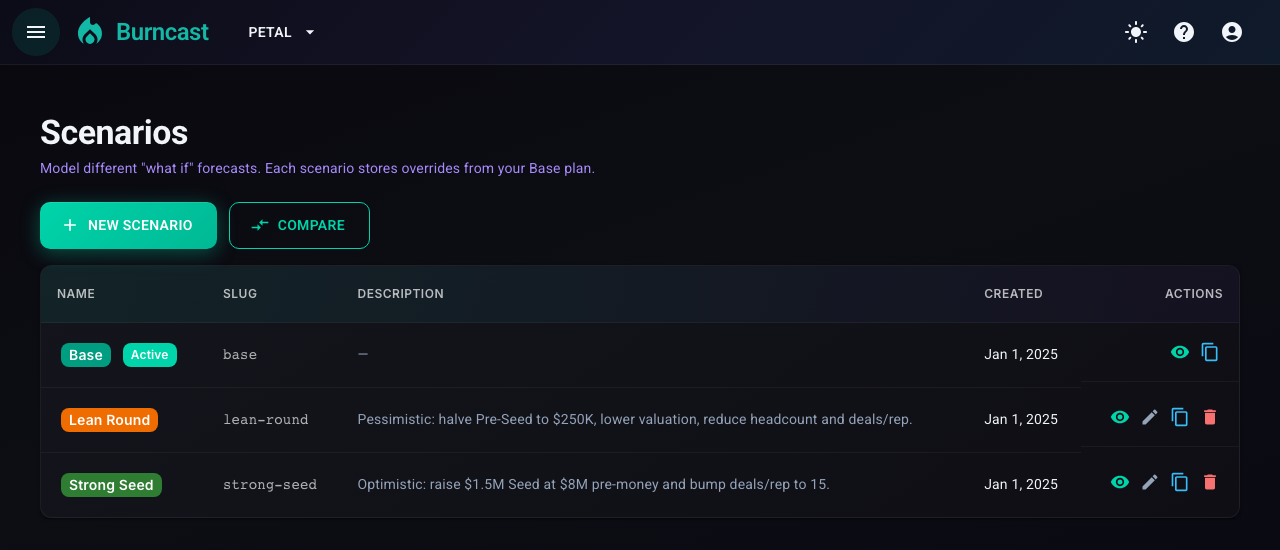
Board meetings happen every quarter. The projections prep shouldn’t consume half your week. But for most founders and CFOs, it does. You open the spreadsheet, realize three months of actual numbers need to be entered, discover that someone’s formula changes broke the summary tab, and spend two days getting the model back to a state where you trust it. Then you duplicate it three times for different scenarios, manually build comparison charts, and paste everything into slides at midnight before the meeting. ...

Your financial model is only as good as the assumptions behind it. Get them right and you have a tool for making decisions. Get them wrong and you have a spreadsheet full of fiction. After watching hundreds of startup models, the same five assumptions trip up founders over and over. Here’s what they are, why they matter, and how to get them closer to reality. 1. Fully-loaded cost per employee Most founders model headcount using base salary alone. That’s a problem. Salary is typically only 60-70% of what an employee actually costs you. ...

You run an accelerator. Twelve companies in the new cohort. Week two, you ask each founder to walk you through their financial model during office hours. Three have Google Sheets, all with different structures and different assumptions. Two have pitch deck slides with projections but no underlying model. Four have nothing. Three built something in Excel that they can’t explain because an advisor made it for them. You spend the next hour helping one founder fix a circular reference instead of talking about whether their hiring plan supports their growth target. ...

Most founders build one financial model. They spend weeks getting the numbers right, defend it to their board, and treat it as a plan to execute. This is exactly backwards. A financial model isn’t a prediction. It’s a tool for thinking through possibilities. And the most useful part of it isn’t the base case you built first. It’s the scenarios you run after. The anchoring problem Daniel Kahneman’s research on cognitive bias identified something called anchoring: once you see a number, it distorts your judgment about what the right number should be. The first estimate you encounter becomes a reference point that’s hard to escape, even when you know it’s arbitrary. ...

It’s your first week as the finance hire at a Series A company. The CEO sends you a Google Sheet with 15 tabs. “Here’s the model,” they say. “The board wants updated projections by Friday.” You open it. Tab names like “Revenue v3 FINAL” and “Headcount (old, don’t use).” Color-coded cells where yellow means assumption and blue means formula, except on the third tab where the colors are reversed. A VLOOKUP references a sheet called “Q3 Scenarios” that no longer exists. The burn rate on the summary tab says $180K/month. The bank account says you’re spending $210K. ...