“What if we only raise half of what we planned?”
“What if churn drops by 5 points after we ship the new onboarding flow?”
“What if we double the engineering team and bet on faster growth?”
These are the questions that shape a startup’s trajectory. But in a spreadsheet, answering any of them means duplicating your entire model, changing the numbers, recalculating runway, and then trying to compare two 14-tab spreadsheets side by side. Most founders either skip the exercise or do it in their head, which is worse.
Burncast now supports scenario modeling as a core feature. A scenario is an alternative version of your financial model where you change a few assumptions and see how the numbers play out differently. Instead of one plan, you maintain several, and compare them. And it works differently from copying a spreadsheet.
Difference-based scenarios
Most tools treat scenarios as full copies. You duplicate everything, change a few numbers, and maintain two independent models. When your base plan changes, and it always changes, you have to update every scenario manually or accept that they’ve drifted.
Burncast uses difference-based scenarios. A scenario only stores what’s different from your base plan. Everything else stays linked.
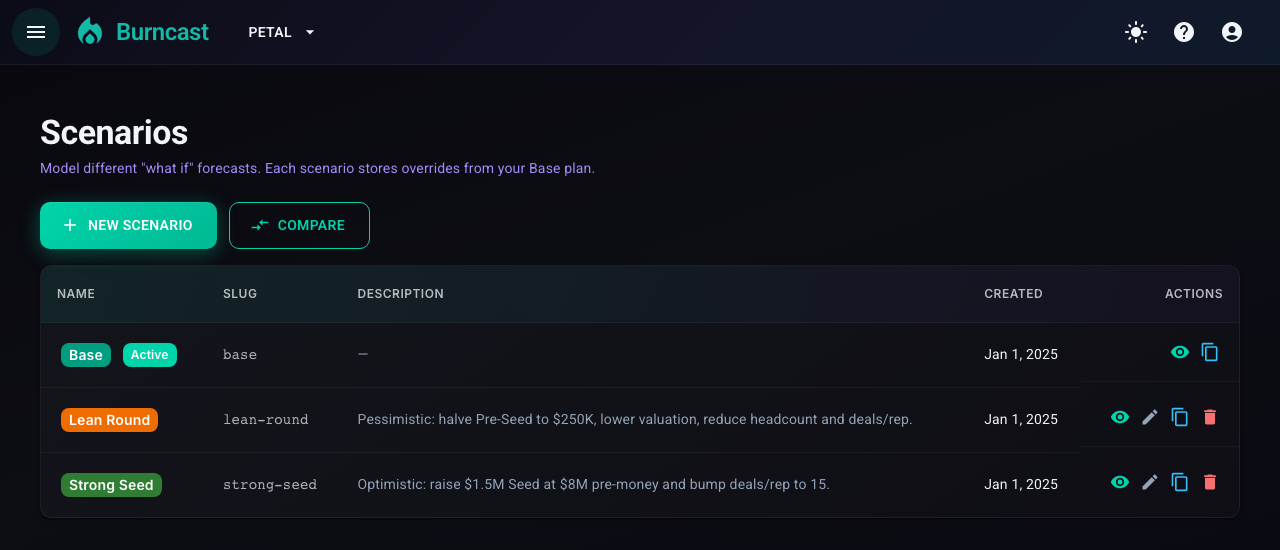
Here’s what that means in practice. Take Petal, a B2B AI ag-tech company selling farm disease-scanning software for $19,999 per year. Their base plan has a $500K pre-seed, a small team ramping up over year one, and sales-driven revenue growth linked to their CEO and an account executive. They create a “Strong Seed” scenario and change a few things: raise a larger $1.5M seed round at $8M pre-money and bump deals per rep from 12 to 15 per year.
That’s all the scenario contains, those deltas. Costs, churn rate, pricing, everything else comes from the base plan. If Petal later updates their base churn rate from 3% to 5%, the Strong Seed scenario automatically reflects that change. No manual sync needed.
They also create a “Lean Round” scenario going the other direction: halve the pre-seed to $250K, lower the valuation, reduce the account executive headcount to 1, and cut deals per rep to 8.
Side-by-side comparison
Here’s Petal’s base plan: a $500K pre-seed, a founding team plus an account executive, and sales-driven revenue at 12 deals per rep per year.
A scenario isn’t useful unless you can see how it compares. Burncast shows each scenario’s dashboard with its own KPIs, so you can switch between them instantly.
The Strong Seed scenario: raise a bigger seed round at a higher valuation and push deals per rep to 15. The bet is that more capital and better sales execution drive faster growth. The dashboard shows how the stronger funding position affects cash flow and runway.
The Lean Round scenario tells the opposite story: halve the pre-seed, reduce the account executive headcount, and lower deals per rep. Less capital, tighter team, but a test of whether the business can survive on less.
Why scenarios matter more than you think
Daniel Kahneman’s research on anchoring bias is relevant here. Once you build a financial model, that single set of numbers becomes your anchor. You start believing your plan is your business, not that it’s one possible version of your business.
Scenarios break the anchor. When you can see three versions of your future side by side, you stop thinking “we’ll have 14 months of runway” and start thinking “we’ll have 11 to 18 months of runway depending on our hiring pace.” That’s a more honest way to plan, and it leads to better decisions.
It also changes board conversations. Instead of presenting one plan and defending every assumption, you show three scenarios and discuss which assumptions drive the biggest differences. The conversation shifts from “is this number right” to “which risks should we prepare for.”
When to create scenarios
Not every decision needs a scenario. Here’s when they’re worth the two minutes it takes to set one up.
Fundraising decisions. Model different raise amounts, valuation terms, and round types. See how a $1.5M seed at $8M pre-money compares to a $250K raise that keeps you leaner but with less dilution. Petal’s Strong Seed and Lean Round scenarios show both paths.
Sales capacity. Your base plan has reps closing 12 deals per year. What if you hire more aggressively or push deals per rep to 15? Create a scenario, change the sales assumptions, and see the impact on revenue and runway.
Revenue uncertainty. You’re projecting sales-driven growth, but what if churn increases or deal sizes shrink? Create a scenario with lower close rates to see how much buffer you need.
Economic downturns. Model a scenario where your sales cycle doubles and churn increases by 3 percentage points. How many months does that cost you? Do you need to cut somewhere to survive?
Try it
You can explore Petal’s full model with all three scenarios in the live demo. Switch between Base, Strong Seed, and Lean Round to see how the numbers change.
Scenario modeling is available now for all Burncast accounts. Open your financial model, click “New scenario,” and start changing assumptions. Your base plan stays intact, and you can compare as many scenarios as you need.
If you don’t have a Burncast account yet, sign up free and build your first financial model. You’ll have scenarios running in minutes.