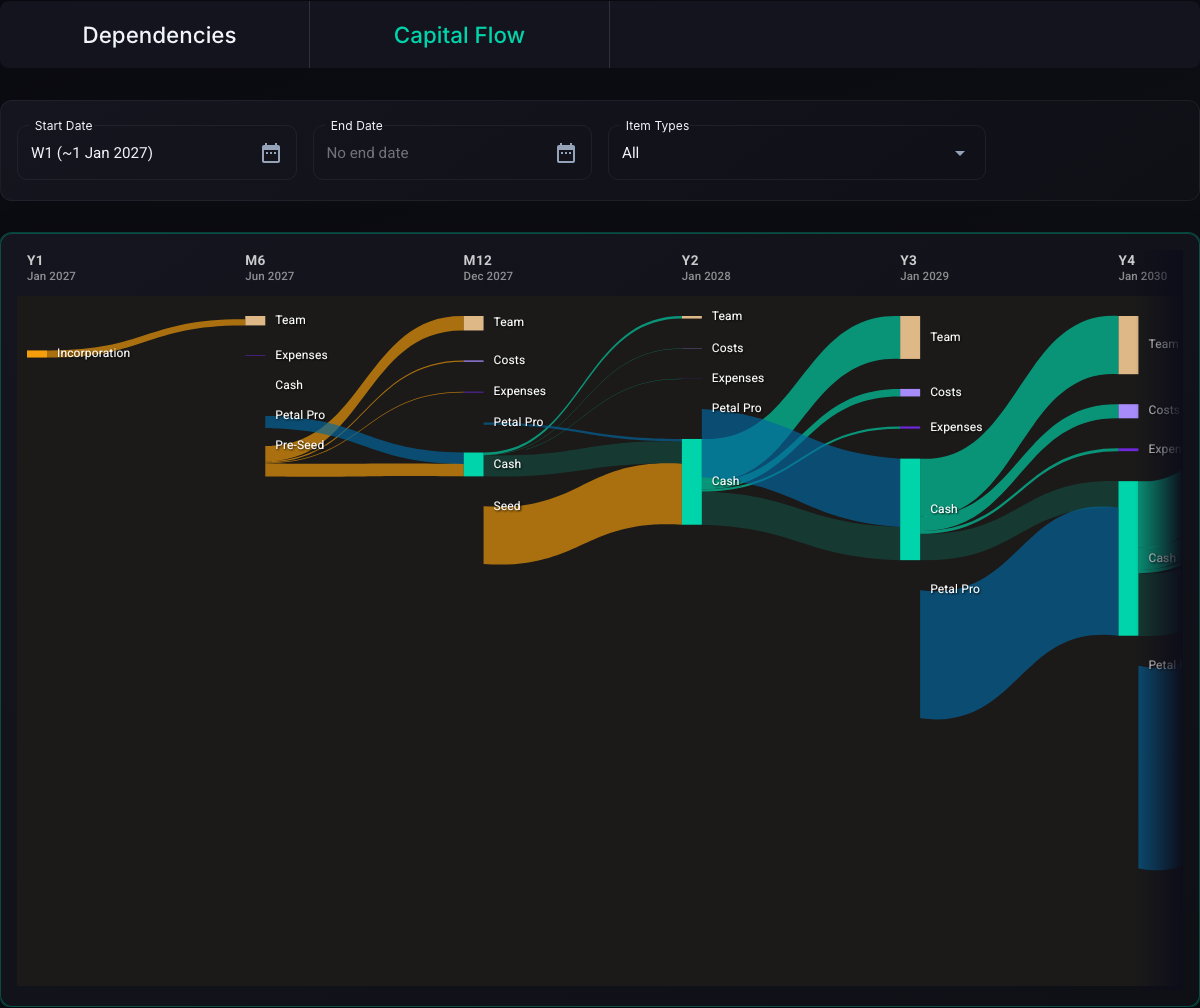
Your budget is the plan. Let it drive the model.

Tie your hiring and spending to your funding, cash, or revenue

Most startup financial models treat hiring plans and budgets as separate things. You plan to raise $4M, and separately you plan to hire 8 engineers. But those two numbers are connected: the engineers are funded by the round. If the round comes in at $2M instead of $4M, the hiring plan should change. In a spreadsheet, you update both manually, then check the statements tab to make sure nothing broke downstream. Change one cell, verify ten others. This is exactly the kind of fragile linking that makes spreadsheet models a liability. ...

April 12, 2026 · 7 min · Burncast
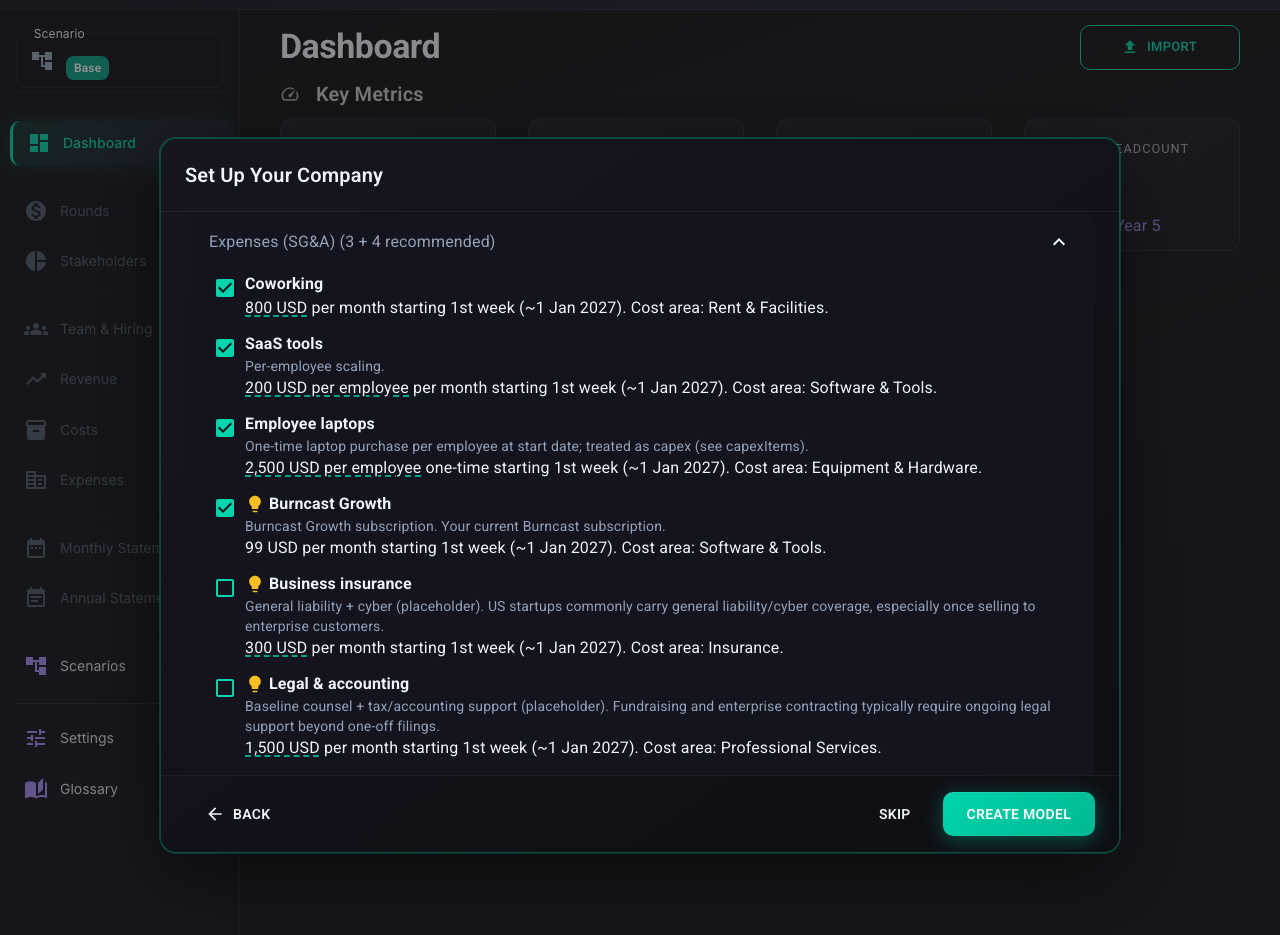
Burncast setup dialog showing recognized and suggested expenses after AI import

Describe your business and let Burncast build the model

Building a financial model usually starts with a blank page and a lot of clicking. Add a team role, fill in salary, set a start date, save. Now do it again for revenue, costs, and funding rounds. By the time you reach the projections tab, you have spent 30 minutes on data entry and have not made a single strategic decision. We wanted to fix that. Starting today, you can describe your business in plain text and Burncast builds the model for you. ...

March 23, 2026 · 5 min · Burncast
Burncast dashboard with interactive lever panel open

Make your models interactive: sliders that update your projections in real time

Three questions every founder should be able to answer in under a minute: What if we raise 50% less than we want? What if we double our growth rate? What if we hire 3 more engineers? These are not hypothetical exercises. They come up in board meetings, investor calls, and late-night planning sessions. But answering them usually means opening a dialog, changing a number, saving, waiting for projections to recalculate, and then undoing everything because you were just exploring. Or worse, if you are using a spreadsheet: changing a cell, scanning downstream formulas for breakage, and hoping you did not miss one three tabs over. Most founders skip it. ...

March 10, 2026 · 7 min · Burncast
Three tools gone. The gap is real.

Finmark is shutting down: what it means for startup financial modeling

BILL is shutting down Finmark on April 1, 2026. If you’re one of the thousands of founders who used it to build their financial model, you need a migration plan in the next two months. But the bigger story isn’t about one product. It’s about what’s happening to an entire category of tools that startups depend on. What Finmark was Finmark was one of the few financial modeling tools built specifically for startups and priced so early-stage companies could actually afford it. At $50/month, it gave founders a structured way to build projections, model revenue, and track burn rate without wrestling with spreadsheet formulas. ...

January 28, 2026 · 5 min · Burncast
Five assumptions. Everything else is just math.

5 assumptions that make or break your startup financial model

Your financial model is only as good as the assumptions behind it. Get them right and you have a tool for making decisions. Get them wrong and you have a spreadsheet full of fiction. After watching hundreds of startup models, the same five assumptions trip up founders over and over. Here’s what they are, why they matter, and how to get them closer to reality. 1. Fully-loaded cost per employee Most founders model headcount using base salary alone. That’s a problem. Salary is typically only 60-70% of what an employee actually costs you. ...

December 9, 2025 · 6 min · Burncast
Your base plan is an anchor. Your scenarios are the insight.

Why your scenarios matter more than your base plan

Most founders build one financial model. They spend weeks getting the numbers right, defend it to their board, and treat it as a plan to execute. This is exactly backwards. A financial model isn’t a prediction. It’s a tool for thinking through possibilities. And the most useful part of it isn’t the base case you built first. It’s the scenarios you run after. The anchoring problem Daniel Kahneman’s research on cognitive bias identified something called anchoring: once you see a number, it distorts your judgment about what the right number should be. The first estimate you encounter becomes a reference point that’s hard to escape, even when you know it’s arbitrary. ...

October 14, 2025 · 5 min · Burncast
15 tabs. Broken formulas. Burn rate doesn't match the bank.

The startup CFO's guide to replacing your inherited spreadsheet

It’s your first week as the finance hire at a Series A company. The CEO sends you a Google Sheet with 15 tabs. “Here’s the model,” they say. “The board wants updated projections by Friday.” You open it. Tab names like “Revenue v3 FINAL” and “Headcount (old, don’t use).” Color-coded cells where yellow means assumption and blue means formula, except on the third tab where the colors are reversed. A VLOOKUP references a sheet called “Q3 Scenarios” that no longer exists. The burn rate on the summary tab says $180K/month. The bank account says you’re spending $210K. ...

September 23, 2025 · 4 min · Burncast
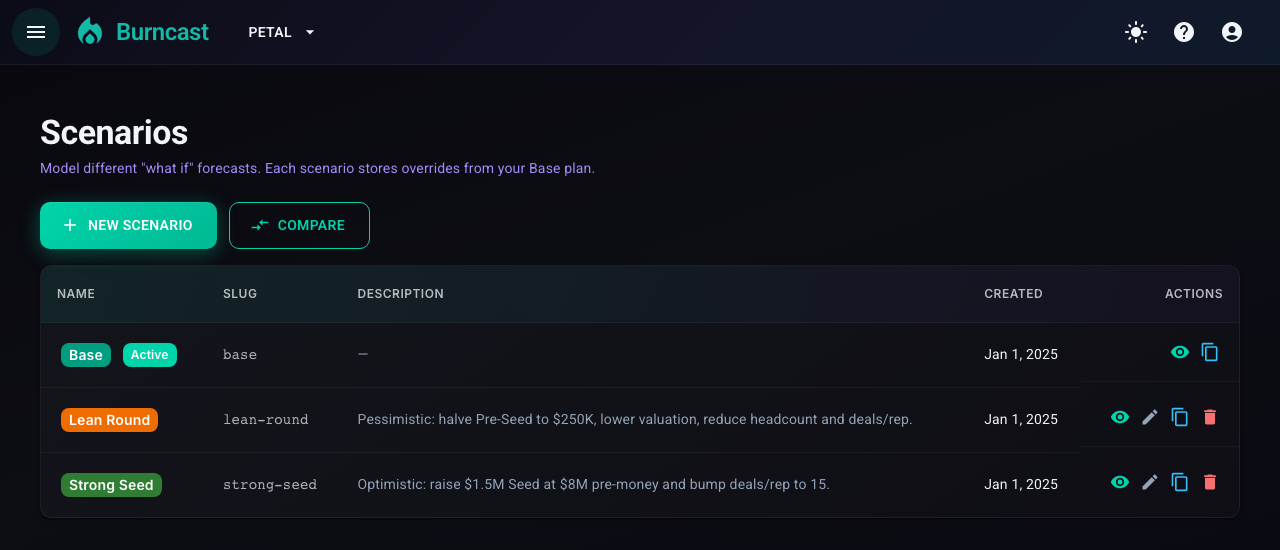
Petal scenario page in Burncast

Explore what-if scenarios for your startup's financial model

“What if we only raise half of what we planned?” “What if churn drops by 5 points after we ship the new onboarding flow?” “What if we double the engineering team and bet on faster growth?” These are the questions that shape a startup’s trajectory. But in a spreadsheet, answering any of them means duplicating your entire model, changing the numbers, recalculating runway, and then trying to compare two 14-tab spreadsheets side by side. Most founders either skip the exercise or do it in their head, which is worse. ...

August 26, 2025 · 5 min · Burncast
$50/month to $10K/year. Nothing in between.

The startup financial modeling gap nobody is filling

Over the past two years, the three tools that best served startup financial modeling have all been acquired and absorbed into larger companies. Finmark was acquired by BILL and is sunsetting in April 2026. Causal was acquired by Lucanet in October 2024. Pry was acquired by Brex for $90M. Each of these products was built specifically for startups. None of them exist independently anymore. This isn’t a coincidence. It’s a pattern worth understanding, because it left a real gap that affects real founders. ...

July 29, 2025 · 4 min · Burncast
Petal AI startup dashboard in Burncast

How to build your first startup financial model in an afternoon

You’ve been writing code for six months. You and your co-founder have a product, a handful of early customers, and a pre-seed round behind you. An investor wants to meet next week and you know they’re going to ask about your financial model. You don’t have one. You’re not even sure what goes in one. This is a normal place to be. Most technical founders haven’t built a financial model before. The problem isn’t intelligence. It’s that startup finance has its own vocabulary and conventions, and nobody teaches them to you until someone asks for a spreadsheet you don’t have. ...

June 17, 2025 · 5 min · Burncast