
Your budget is the plan. Let it drive the model.

Tie your hiring and spending to your funding, cash, or revenue

Most startup financial models treat hiring plans and budgets as separate things. You plan to raise $4M, and separately you plan to hire 8 engineers. But those two numbers are connected: the engineers are funded by the round. If the round comes in at $2M instead of $4M, the hiring plan should change. In a spreadsheet, you update both manually, then check the statements tab to make sure nothing broke downstream. Change one cell, verify ten others. This is exactly the kind of fragile linking that makes spreadsheet models a liability. ...

April 12, 2026 · 7 min · Burncast
88% of spreadsheets contain errors.

Your spreadsheet financial model is a liability

A founder I know discovered last year that her runway was off by four months. Not because her assumptions were wrong. Because a SUM range in row 47 didn’t include the last three hires she’d added to the team sheet. The formula referenced B12:B24. Her team list went to B27. She’d been making hiring decisions based on a number that was silently, confidently wrong. No error message. No red cell. Just a clean-looking spreadsheet telling her she had until March when she actually had until November. ...

May 20, 2025 · 4 min · Burncast
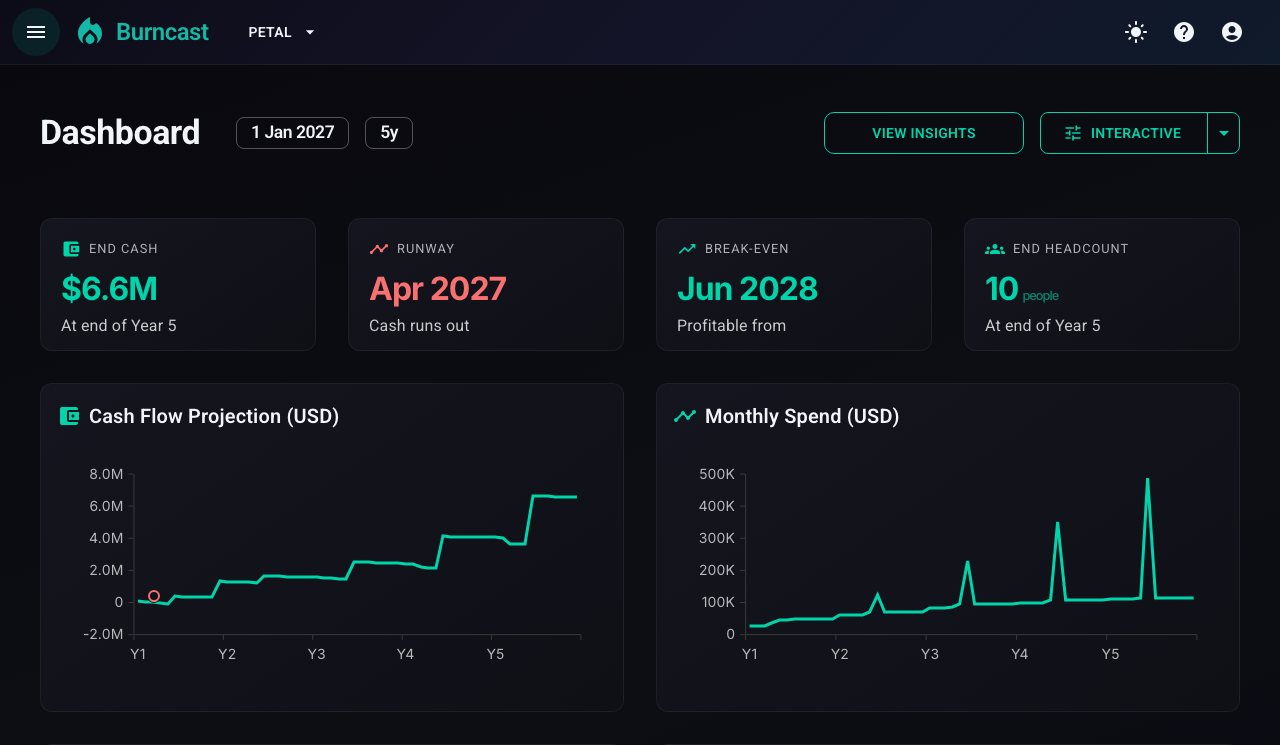
Burncast dashboard with KPI cards and financial charts

Introducing Burncast: the financial model your startup actually needs

Every startup founder has lived this moment: you open a Google Sheet, stare at a blank grid, and try to turn your business into rows and columns. Maybe you download a template. Maybe you copy one from a friend who raised a Series A. Either way, you spend the next two weeks building something fragile, praying nobody asks you to change an assumption. We built Burncast because that process is broken, and it doesn’t have to be. ...

April 15, 2025 · 3 min · Burncast